- Products
- Spaces
- Brands
- Our offers
- Second Life
- New products
- About
- Contact us
- Our CSR commitments
- Our Showrooms
- Request a quote
- Professional space
- General catalogue

Enjoy all the benefits we offer and track your purchases in the order history.
RegisterYou will receive a link by email to reset your password.
- Home
- ▸
- designers
Le Corbusier
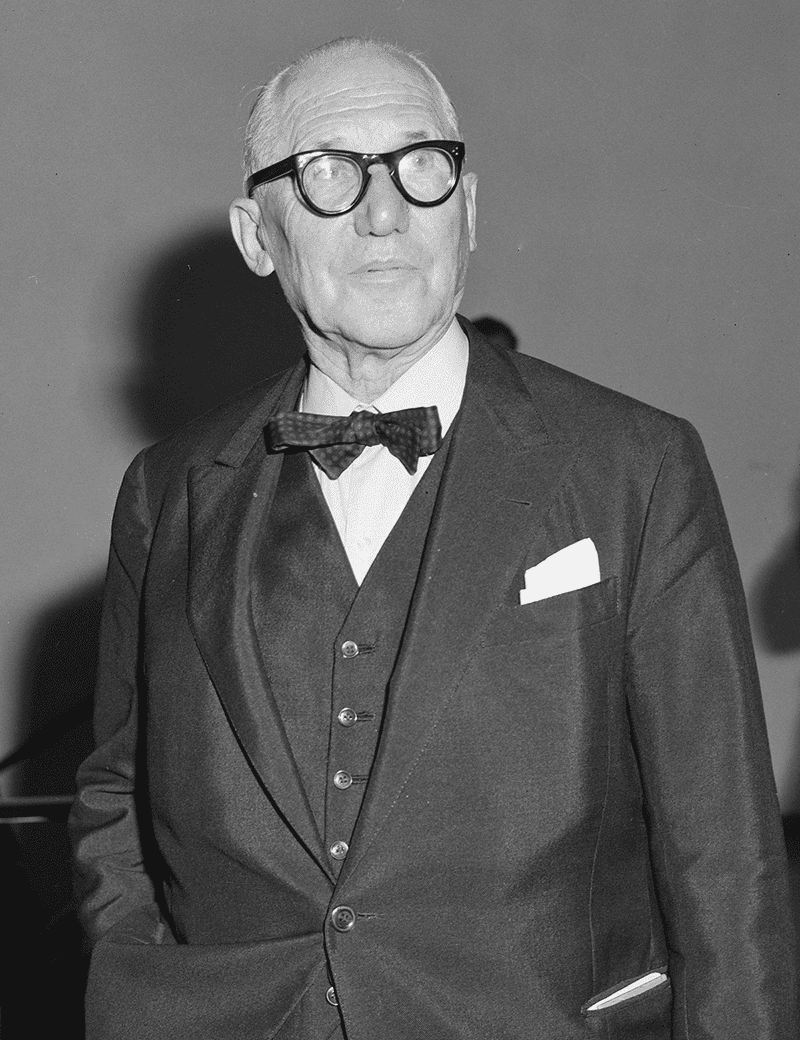
Le Corbusier, born Charles-Édouard Jeanneret (1887–1965), was one of the most influential architects of the 20th century and a central figure of modernism. Through his architectural works, theories, and furniture designs, he profoundly shaped contemporary architecture.
His work centers on the idea of functional, rational, and aesthetic architecture—one that responds to human needs while embracing modern technologies. One of his most famous projects is the Villa Savoye (1928–1931) in Poissy, a manifesto of the modern movement. This building embodies his fundamental architectural principles, with its clean lines, use of concrete, glass, and steel, and its open spatial layout.
Here, Le Corbusier introduces the concept of the house as a “machine for living,” maximizing functionality while maintaining a pure, streamlined design. Another iconic project is the Cité Radieuse (1947–1952) in Marseille, a residential complex that reflects his vision of optimized, self-sufficient collective housing—a project that greatly influenced modern urban planning.
Alongside his architectural work, Le Corbusier designed numerous pieces of furniture, often in collaboration with designers such as Charlotte Perriand and Pierre Jeanneret. Among the most iconic pieces are the LC2 armchair, known for its comfort and simplicity, and the LC4 chaise longue, a model that embodies both elegance and functionality.
These creations are now icons of modern design, celebrated for their minimalist aesthetics and comfort. Le Corbusier was also an influential theorist, notably through his book Towards an Architecture (1923), in which he advocated for an architecture based on logic, geometry, and the use of modern materials.
His ideas laid the foundations of modern architecture and had international reach, shaping the way buildings and spaces are still conceived today. His legacy remains powerful, and his contributions to architecture, urban planning, and furniture design continue to influence contemporary practice. Le Corbusier not only transformed how buildings are designed but also how we live in and interact with the spaces around us.