
- Products
- Spaces
- Brands
- Our offers
- Second Life
- New products
- About
- Contact us
- Our CSR commitments
- Our Showrooms
- Request a quote
- Professional space
- General catalogue

Enjoy all the benefits we offer and track your purchases in the order history.
RegisterYou will receive a link by email to reset your password.
- Home
- ▸
- designers
Florence Knoll
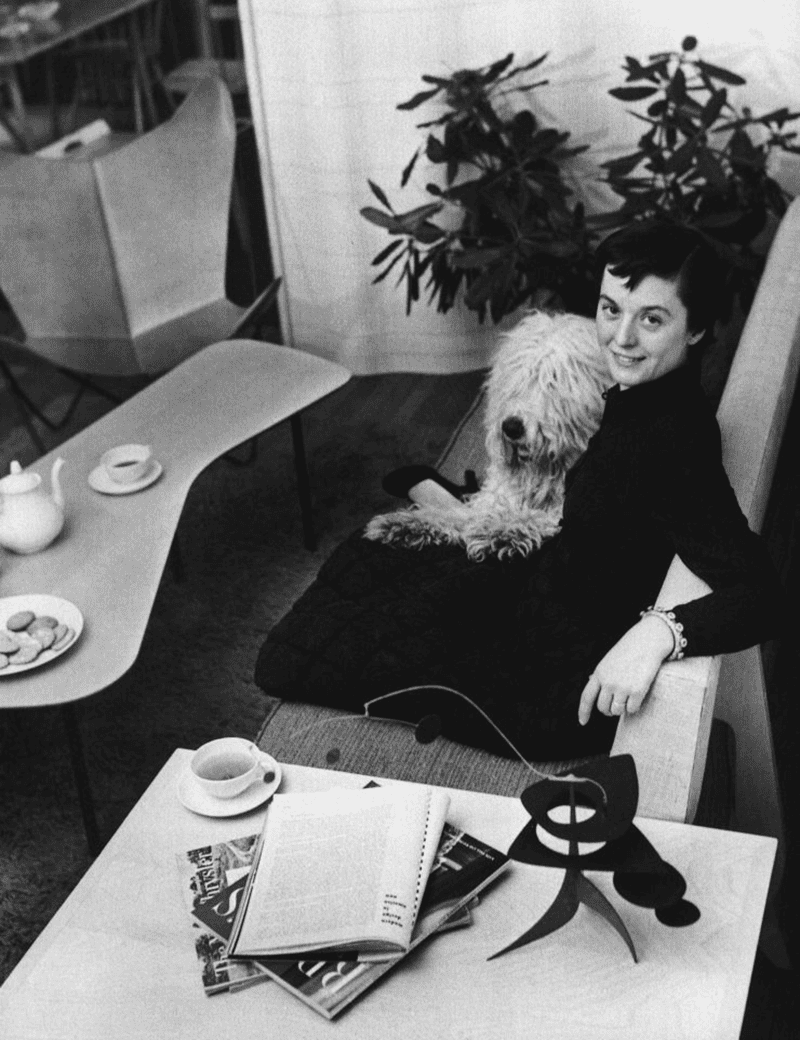
Florence Knoll (1917–2019) is one of the iconic figures of modern American design and a pioneer in the field of furniture.
A graduate in architecture from the University of Michigan’s School of Architecture, she continued her studies in Europe, where she attended the Academy of Fine Arts in Berlin before joining the Massachusetts Institute of Technology.
It was during her years in Europe that she met influential figures such as Ludwig Mies van der Rohe and Alvar Aalto, whose impact would deeply shape her approach to design.
In 1943, Florence Knoll founded Knoll Associates with her husband, Hans Knoll, and quickly became the company’s design director. She revolutionized the furniture industry by blending the principles of European modernism with American efficiency and pragmatism.
Her work is renowned for its elegant simplicity, functionality, and refinement. Florence Knoll played a key role in shaping the brand identity of the company, creating furniture that is both modern and timeless.
Among her most famous contributions is the Knoll Planning Unit, a series of modular and functional furniture pieces designed to optimize office spaces, which perfectly embodies her methodical design approach. She also designed the celebrated Womb Chair and the End Table for Knoll, two pieces that combine comfort with minimalist aesthetics.
Florence Knoll also played an important role in democratizing designer furniture, making modern furniture accessible to a wider audience thanks to her forward-thinking vision of office design.
She was the first to conceive functional and ergonomic workspaces that met the needs of industry while honoring the aesthetic principles of modernism.
Her work has been widely recognized over the years, and her creations remain among the most sought-after pieces in the world of design. Florence Knoll left a profound mark on design history through her ability to unite form, function, and aesthetics, and she remains one of the most influential designers of the 20th century.

